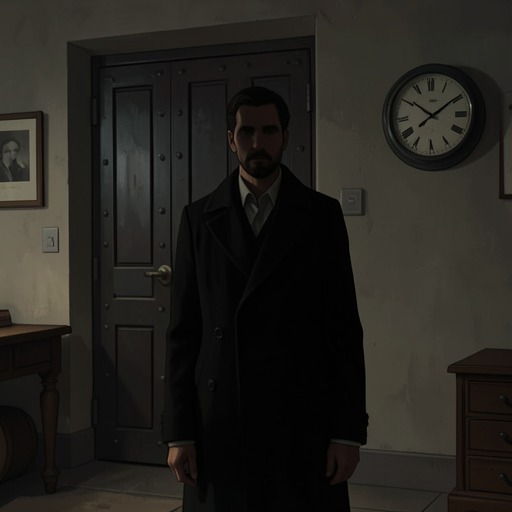
Werner Stahl
The Glass RoomWerner Stahl is a Nazi officer involved in the biometric operation established in the Landauer House. He presents his work as anthropology and the measurement of human beings, but its purpose is to classify people by race, including determining whether someone is Jewish. His encounters with Hana Hanáková make the gap between scientific authority and personal conduct increasingly stark: the man who claims to measure others is himself unable to control the intimate and political conflicts surrounding him.
Identity and Role
Stahl appears in the section titled “Occupation,” arriving in a car before asking the driver to continue without him. He walks alone up the hill to the Landauer House, a building that has become a Nazi facility. The scene sets his official role against an ordinary, quiet suburban landscape, but his destination makes clear the force behind the new occupation of the house.
He describes his purpose to Laník as scientific research, naming anthropology, biometrics, and the measurement of man. The promise of measurement is also a threat: Stahl says Laník will be measured and told whether he is Jewish. Classification is presented as an administrative and scientific procedure, yet it carries direct consequences for the person subjected to it. Stahl’s language therefore joins clinical authority to the coercive racial order the facility serves.
The Biometric Centre
The Landauer House is converted into a functioning research centre. Stahl arrives there as the premises are equipped with chairs, shelving, desks, and filing cabinets; a guard hut is assembled inside the gate, and a sign bearing the Nazi emblem identifies the institution as the Rasse- und Siedlungshauptamt. The transformation is not merely a change of use: a private modernist home becomes an instrument of occupation and racial administration.
The centre’s work connects local measurement to a larger system of records. In the facility, researchers and assistants process files, while information is sent onward to Prague and Berlin for machine sorting and analysis. Stahl’s own file requests make him part of this bureaucracy. A folder bearing the institutional heading and Hana’s name is brought to him, and he asks whether it has passed through the Hollerith section. The exchange links individual classification to a system that aims to make patterns of race and identity legible through records and machinery.
Stahl presents himself as a researcher among others, but his authority is also personal. When a woman challenges the idea of private use of the measuring facilities, he assures her of his discretion. Her distrust and sardonic intelligence unsettle his usual confidence in assessing people. The scene reverses the clinic’s customary relation of authority: the person who expects others to submit to medical expertise finds himself unable to read or direct the woman before him.
Hana Hanáková and Private Entanglements
Stahl’s relationship with Hana develops in the shadow of the institution where he works. At a cabaret, a singer’s performance interrupts a conversation about Stahl’s childlessness and his grief over Hedda. Hana leads him onto the dance floor; he finds the physical closeness soothing, while she responds to his discomfort with amusement. They leave for a hotel room. The episode shows him seeking relief from private loss through intimacy, even as he occupies a position of power within the racial regime.
The relationship does not give Stahl insight into Hana. He assures her that he can be discreet, but she remains distrustful and sardonic. When she tells him that her husband is Jewish, her statement makes the contradiction between his private involvement with her and his public role in a persecution system unmistakable. Stahl has been explaining isolation as policy; Hana answers from the position of someone whose marriage places her close to the people that policy targets. The disclosure challenges the abstraction of racial categories with a specific human relationship.
Another confrontation brings the power imbalance into the open. Stahl strikes Hana during an argument and seizes her wrist when she tries to move away. Afterwards, he tells himself that the conflict is over and that he is back in control. He takes her home because the curfew prevents her from returning alone. His apparent caretaking follows his use of force, making the episode a study in how domination can be recast, by the person exercising it, as restored order or concern.
Conflict and Significance
Stahl’s conduct is marked by the same gap between the language of rational control and the realities it conceals. At the biometric centre, measurement is described as science, but it sorts people into a racial hierarchy. In his encounters with Hana, he claims discretion and authority but cannot control what she reveals or how she judges him. His position gives him institutional power; it does not make him ethically or emotionally secure.
The file bearing Hana’s name sharpens that conflict. She is not only a person with whom Stahl has a private relationship but also the subject of a record moving through the institution’s machinery. The juxtaposition makes the centre’s claimed neutrality untenable: intimate knowledge, bureaucratic classification, and state power converge on the same person. Stahl’s role thus helps expose the human consequences of a system that treats identity as something to be measured and processed, while his own encounters repeatedly show the limits and distortions of that supposed objectivity.